

TL;DR: Why Regular Car Battery Maintenance is Important
Car battery maintenance helps drivers identify battery problems before they cause a breakdown. Regularly checking battery age, terminal condition, voltage, charging performance, corrosion, and warning signs can significantly reduce the risk of unexpected starting failures and extend battery life. Most vehicle batteries last between three and five years when properly maintained.
If your vehicle starts slowly, battery terminals show corrosion, headlights appear dim, or the battery is more than three years old, it’s time to perform a complete battery inspection. A simple car battery checklist can help detect problems early, improve reliability, and prevent expensive roadside assistance callouts.
For drivers wanting to improve overall vehicle reliability, I also recommend reading our guide on essential travel gear convenience accessories that help during emergencies and road trips.
What’s Inside? (Quick Glance)
Why a Car Battery Checklist Matters
Most drivers never think about their car battery until the day the engine refuses to start. The problem is that battery failure rarely happens at a convenient time. It usually occurs when you’re running late for work, preparing for a road trip, collecting children from school, or parked in a remote location. By then, the warning signs have often been present for weeks or even months.
A battery is one of the hardest-working components in any vehicle. Every time you start the engine, operate electrical accessories, charge devices, run climate control systems, or power modern driver assistance features, the battery is involved. Yet it remains one of the most overlooked maintenance items.
In workshop vehicles I’ve serviced over the years, battery-related issues are among the most common causes of avoidable breakdowns. Many owners replace starters, alternators, or sensors before discovering that a weak battery was the real culprit all along.
A proper car battery checklist is not about becoming a mechanic. It is about spending a few minutes periodically checking key indicators that reveal whether your battery is healthy or heading towards failure.
According to AAA, dead batteries remain one of the leading causes of roadside assistance calls every year.
For additional automotive reliability upgrades, check our detailed guide on off-road car accessories.
What Kills Car Batteries Faster Than Normal?
1. Short Trips Are Brutal on Batteries
This is probably the biggest battery killer I see. If you’re only driving 5–10 minutes at a time, your alternator doesn’t have enough time to fully recharge the battery after starting the engine.
One customer used their vehicle only for school drop-offs and grocery runs. After replacing two batteries within three years, we tested the charging system and found nothing wrong mechanically. The real issue was the driving pattern itself. I told them: “Your battery spends more time draining than charging.”
After they started taking the car on a 30-minute highway drive once a week, battery problems disappeared.
2. Heat Damages Batteries Faster Than Cold
Most people blame winter for dead batteries, but extreme heat actually causes more long-term damage.
Living in Australia, I’ve seen summer temperatures absolutely cook batteries. Heat evaporates internal battery fluid and accelerates chemical breakdown inside the cells. If possible:
- Park in shaded areas
- Use a garage during heat waves
- Inspect batteries more often during summer
3. Loose or Corroded Terminals
A battery can test healthy and still fail to start your vehicle if terminal connections are poor.
I once worked on a sedan that randomly lost power while driving. The owner had already replaced the battery themselves, but the issue remained. Turns out the negative terminal clamp wasn’t fully tightened. That tiny loose connection caused:
- Intermittent voltage drops
- Dashboard resets
- Engine hesitation
Took five minutes to fix. Sometimes it really is the simple stuff.
Best Car Battery Maintenance Products
You don’t need expensive workshop equipment. Here’s what you should actually keep in your garage:
- Wire brush or terminal cleaner
- Baking soda and water
- Gloves
- Multimeter
- Small wrench set
- Battery terminal protector spray
After more than 10 years working as a diagnostic technician, these are the tools I actually keep in my garage for regular car battery maintenance. A reliable multimeter like the Innova 3320 Digital Multimeter makes checking battery voltage incredibly easy, especially for beginners. For cleaning corrosion fast, I’ve had great results using the ToolPRO Battery Post and Terminal Cleaner because it reaches inside the terminal clamps properly instead of just cleaning the surface.
I also recommend keeping a can of CRC Battery Terminal Protector nearby after cleaning terminals. It helps slow future corrosion buildup, especially in humid or coastal areas where battery terminals tend to corrode faster.
Check the product review on car battery maintenance tool here
Car Battery Maintenance Checklist/ Car Battery Maintenance Tips
1. Visual Inspection
The first step requires no tools whatsoever. Simply open the bonnet and examine the battery carefully. Many battery problems leave visible clues long before complete failure occurs.
Look for swelling around the battery casing. Excessive heat can damage internal battery components, causing the case to expand. A swollen battery should never be ignored because internal damage has usually already occurred.
Check for cracks, leaks, or any signs of fluid escaping from the battery housing. These issues can indicate structural failure and often require immediate replacement.
Next, examine the battery hold-down bracket. A loose battery may vibrate excessively while driving, which can damage internal plates and shorten service life.
This quick inspection often reveals problems that many owners never notice until the battery stops working entirely.
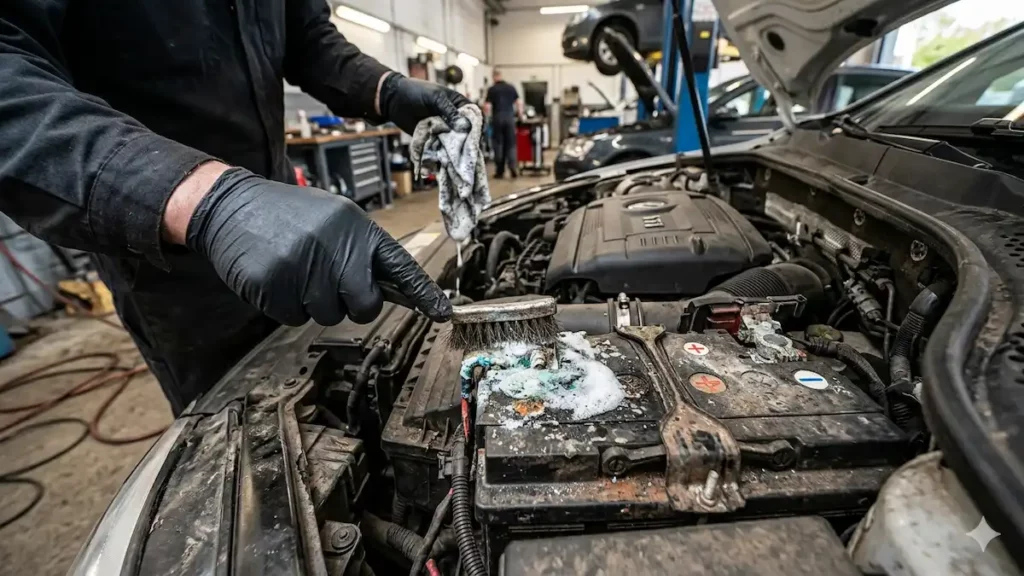
2. Clean Battery TeCheck Battery Terminals for Corrosion
Corrosion is one of the most common battery-related issues encountered in workshops. It usually appears as a white, green, or bluish powdery substance around battery terminals and cable connections.
Although it may look harmless, corrosion increases electrical resistance. That resistance restricts current flow between the battery and the vehicle’s electrical system.
The result can be:
- Slow engine cranking
- Charging problems
- Intermittent electrical faults
- Reduced battery performance
When inspecting the terminals, check whether the cable clamps feel secure. Loose connections can create symptoms similar to a failing battery.
If mild corrosion is present, it can often be cleaned carefully using appropriate battery terminal cleaning methods. Severe corrosion or damaged terminals should be professionally inspected.
One pattern I’ve repeatedly seen in workshop diagnostics is drivers replacing a perfectly good battery when the actual problem was simply a heavily corroded connection.
3. Listen to How the Engine Starts
Your ears can provide valuable diagnostic information. A healthy battery usually cranks the engine with confidence and consistency.
If you notice the starter motor turning noticeably slower than usual, especially during colder mornings, the battery may be losing its ability to deliver sufficient power.
Pay attention to changes rather than isolated incidents. A gradual decline in cranking speed is often one of the earliest signs of battery deterioration. Many drivers ignore this warning because the vehicle still starts.
The reality is that batteries rarely move directly from healthy to dead. They typically go through a period of gradual decline first.
Recognising this change early gives you time to test or replace the battery before a complete failure occurs.
4. Inspect Headlights and Electrical Components
Another useful checklist item involves observing your vehicle’s electrical performance. Weak batteries frequently affect electrical systems before causing starting issues.
Watch for:
- Dim headlights
- Flickering interior lights
- Slow power windows
- Delayed central locking operation
- Dashboard warning lights
These symptoms do not automatically confirm battery failure because charging system faults can produce similar behaviour. However, they should never be ignored.
Modern vehicles rely heavily on stable voltage levels. Even minor battery weakness can create unusual electrical symptoms that appear unrelated at first glance.
In many diagnostic cases, mysterious electronic complaints ultimately trace back to battery health problems.
Check the Battery’s Age
This is arguably the simplest item on any battery checklist. Locate the manufacturing date on the battery label. Many batteries include either a date sticker or a coded production marking.
Once a battery passes three years of age, increased monitoring becomes sensible. After four or five years, replacement planning should be considered even if no obvious symptoms are present.
A battery that seems fine today may not survive the next heatwave or cold snap. Age alone does not condemn a battery, but it provides important context when evaluating other warning signs.
How to Test Battery Voltage Properly
A visual inspection can reveal a lot, but it cannot tell you how much usable power remains inside the battery. For that, you need a voltage test.
Fortunately, testing battery voltage is straightforward and can be done at home with a digital multimeter.
With the engine switched off and the vehicle sitting for several hours, connect the multimeter leads to the battery terminals. A healthy, fully charged 12-volt battery should generally read around 12.6 volts. Readings around 12.4 volts suggest the battery is partially discharged, while readings below 12.2 volts often indicate a battery that requires charging or further testing.
What many drivers don’t realise is that voltage alone does not always reveal battery condition. I’ve seen batteries show acceptable voltage readings but fail under load because internal components had deteriorated. That is why voltage testing should be viewed as one part of a complete battery health assessment rather than the only test.
If your battery repeatedly shows low voltage despite regular driving, further investigation may be needed to determine whether the battery itself is failing or whether the charging system is underperforming.
Don’t Ignore the Vehicle’s Charging System
Many batteries get blamed for problems caused by something else. The alternator and charging system are responsible for replenishing battery power while the engine is running. If the alternator cannot maintain proper charging voltage, even a new battery can become discharged and appear faulty.
After testing the battery with the engine off, start the vehicle and check voltage again. In most vehicles, charging voltage should typically fall between approximately 13.7 and 14.7 volts while the engine is running.
Values significantly outside this range may indicate charging system issues that require professional diagnosis.
In workshop diagnostics, one common mistake is replacing the battery without checking the alternator. The vehicle starts normally for a short period because the new battery is fully charged, but the underlying charging problem remains unresolved. A few weeks later, the same symptoms return and the owner ends up paying twice.
This is why any thorough car battery checklist should include charging system awareness, not just battery inspection.
Warning Signs Your Battery Is Starting to Fail
Battery failure is rarely completely unexpected. Most batteries provide warning signs beforehand, although these warnings are often dismissed as minor inconveniences.
Repeated jump-starts are one of the strongest indicators that a battery may be reaching the end of its service life. While a single flat battery can occur because of lights being left on, recurring discharge events usually point towards a deeper issue.
Slow engine cranking remains one of the clearest signs. Drivers often notice the engine sounds slightly sluggish during startup, especially in the morning.
Another common symptom involves electrical irregularities. Dashboard warning lights may behave unusually, infotainment systems may restart unexpectedly, or electronic features may seem less responsive than normal.
Some vehicles also display battery-related warning messages directly through the instrument cluster.
The key point is that warning signs tend to appear gradually. Paying attention to these early clues can help prevent the inconvenience of a complete no-start situation.
Seasonal Car Battery Checklist
Environmental conditions have a major impact on battery performance. Many people assume winter is the biggest threat to batteries because cold weather makes starting more difficult. While cold temperatures certainly expose weak batteries, excessive heat often causes more long-term battery damage.
During summer, inspect the battery more frequently for swelling, fluid loss, and heat-related deterioration. High temperatures accelerate chemical ageing inside the battery and can significantly reduce lifespan.
Before winter arrives, ensure the battery is fully charged and tested. Cold conditions increase the amount of power required to crank the engine while simultaneously reducing available battery performance.
Seasonal inspections should also include checking terminal cleanliness, securing cable connections, and verifying that the charging system is functioning correctly.
Drivers who perform these simple seasonal checks are often far less likely to experience sudden battery failures during extreme weather.
Common Battery Maintenance Mistakes Drivers Make
Many battery problems stem from avoidable habits rather than unavoidable ageing. One common mistake is relying exclusively on short trips. Vehicles driven only for brief journeys may never fully recharge the battery. Over time, repeated partial charging can contribute to reduced battery performance.
Another issue involves leaving electrical accessories operating when the engine is switched off. Interior lights, dash cameras, charging devices, and entertainment systems can gradually drain battery reserves.
I’ve also encountered vehicles where owners ignored corrosion for months because the car still started normally. By the time they sought assistance, terminal damage had become extensive and repairs were more expensive than necessary.
A further mistake involves installing the wrong replacement battery. Modern vehicles often require batteries with specific capacity, reserve power, or start-stop compatibility.
Choosing a battery based solely on physical size can lead to performance issues and reduced lifespan. Regular inspections help identify these problems before they become costly.
Practical Maintenance Tips That Can Extend Battery Life
Battery maintenance does not require advanced mechanical knowledge. Keeping terminals clean remains one of the simplest ways to support reliable performance. Clean connections reduce resistance and improve charging efficiency.
If the vehicle will remain unused for extended periods, consider using a battery maintainer. These devices help preserve charge levels and reduce deterioration caused by long-term inactivity.
Try to combine multiple short trips into longer journeys whenever possible. This allows the alternator more time to restore battery charge.
Regular servicing also plays a role. During routine maintenance visits, ask for a battery and charging system test. Many workshops can perform these checks quickly and identify developing problems before they cause breakdowns.
In vehicles I’ve worked on throughout the years, batteries that receive occasional inspection and preventative maintenance often achieve noticeably longer service lives than neglected units.
Buyer’s Guide: Choosing the Right Replacement Battery
Eventually, every battery reaches the end of its service life. When replacement becomes necessary, selecting the correct battery is more important than many drivers realise.
The first consideration should always be the vehicle manufacturer’s specifications. Battery size, capacity, cold cranking performance, and terminal layout all need to match vehicle requirements.
Vehicles equipped with start-stop technology often require specialised battery types such as AGM (Absorbent Glass Mat) or EFB (Enhanced Flooded Battery) designs. Installing a conventional battery where a specialised battery is required can lead to charging problems and shortened battery life.
Warranty coverage is another important factor. Longer warranties may provide additional peace of mind, although overall product quality and suitability remain more important than warranty length alone.
Price should never be the only deciding factor. A low-cost battery that fails prematurely can become more expensive than a quality battery that delivers years of reliable service.
When in doubt, consult manufacturer recommendations or a qualified battery specialist before purchasing.
Vehicles with start/stop systems usually require AGM batteries. Installing the wrong type can create charging issues and shorten battery life dramatically. Helpful resource:
Battery Council International
When Should You Replace a Car Battery?
Many drivers wait until complete failure occurs. A more practical approach involves proactive replacement when multiple warning signs begin appearing together.
Consider replacement if:
- The battery is more than four to five years old.
- Starting performance has noticeably deteriorated.
- Voltage testing consistently shows weak results.
- Corrosion or physical damage is present.
- The battery repeatedly requires jump-starting.
Replacing a battery before complete failure often provides greater convenience and avoids the stress associated with unexpected breakdowns.
Final Thoughts
A car battery checklist is not simply about checking another maintenance item. It is about protecting yourself from one of the most common causes of vehicle breakdowns.
By routinely inspecting battery condition, monitoring age, checking terminals, testing voltage, and paying attention to warning signs, you dramatically improve the chances of catching problems before they leave you stranded.
In workshop vehicles I’ve inspected over the years, the majority of battery failures were not truly unexpected. The clues were there. They simply went unnoticed until the vehicle refused to start.
The best approach is preventative rather than reactive. A few minutes spent performing a battery inspection today can save hours of inconvenience and potentially hundreds of pounds or dollars in emergency expenses later.
If your battery is approaching the end of its lifespan or showing multiple warning signs, schedule a professional battery and charging system test before the next breakdown chooses the timing for you.
Car Battery Maintenance FAQs
How often should I check my car battery?
A basic visual inspection every month is usually sufficient for most vehicles. More comprehensive testing should be performed before long road trips, during seasonal changes, or once the battery reaches three years of age.
What voltage should a healthy car battery show?
A fully charged 12-volt battery generally reads around 12.6 volts with the engine switched off. Lower readings may indicate discharge or developing battery issues.
Can a battery fail without warning?
While sudden failures can occur, most batteries provide warning signs such as slow cranking, electrical issues, repeated jump-starts, or reduced performance before complete failure.
Does frequent short-distance driving damage a battery?
Short trips can contribute to battery problems because the alternator may not have enough time to fully recharge the battery after starting the engine.
Should I replace a battery before a long trip?
If the battery is approaching the end of its expected lifespan or showing warning signs, replacement before a major journey can reduce the risk of roadside breakdowns.
How long do most car batteries last?
Most vehicle batteries typically last between three and five years, although climate, maintenance practices, and driving habits can significantly influence lifespan.
Can corrosion cause starting problems?
Yes. Corrosion increases electrical resistance and can interfere with power flow between the battery and vehicle systems, leading to slow cranking or starting difficulties.
Thank you for this very helpful advice. I tend to do a lot of short trips during the week, and now know that I must try and take my car out for a bit more of a drive each week to recharge the battery properly. Luckily I haven’t had issues yet, but it is still a relatively new car.
I think everyone should also have a reliable multimeter in their garage, as in this way you will know exactly where you stand with your battery health. I also make a point of taking a fully charged battery charger around with me at all times just in case of an emergency.
Hi Michel,
Thank you very much for sharing your thoughts. Yes we should be prepared for the unexpected scenarios. Enjoy your travels.
Great information here. I am happy to have found this useful article. It is full of very practical information. Thank you for your hard work.
Hi Michael,
Thank you very much for your feedback.