
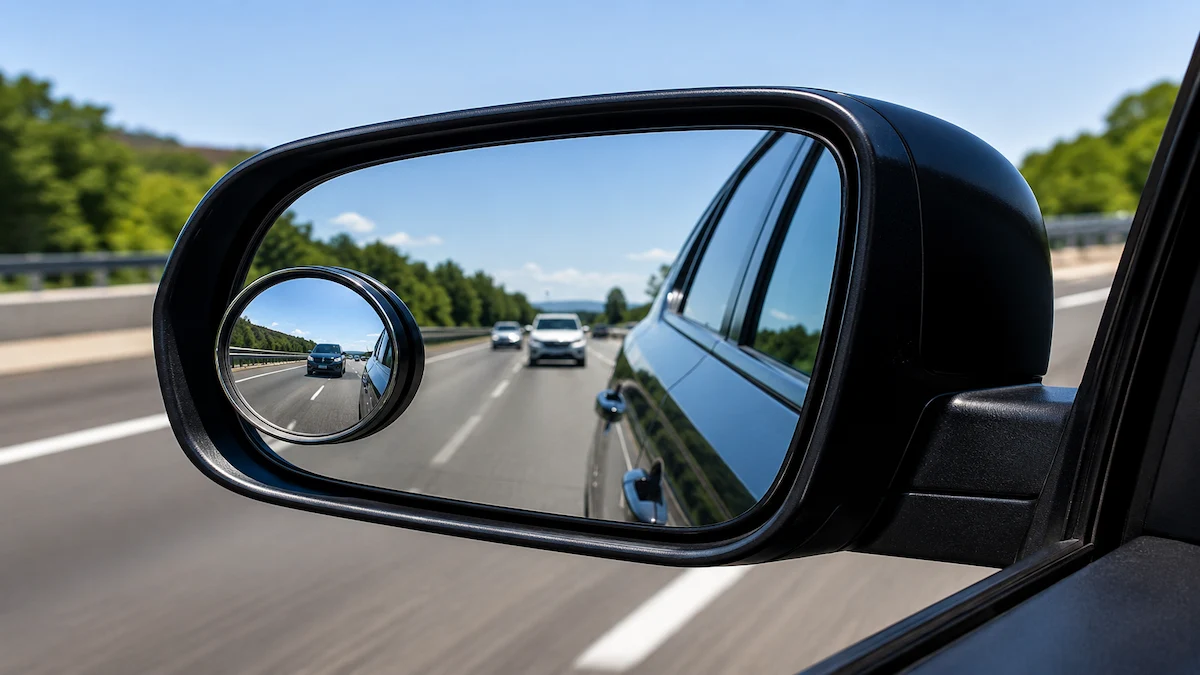

TL;DR: What are Blind Spot Mirrors
Blind spot mirrors are small convex mirrors that stick onto your existing side mirrors to widen your field of view. They can be worth buying if you want extra visibility during lane changes, reversing or parking, especially on SUVs, utes, vans and older cars without blind spot monitoring. The best blind spot mirrors use clear glass, strong adhesive, sensible sizing and proper placement. They help reduce hidden areas, but they do not replace correct mirror adjustment or a proper shoulder check.
Blind spot mirrors are one of those cheap car accessories people either swear by or dismiss as a gimmick. Most of the time, that comes down to one simple problem: they bought the wrong type, stuck it in the wrong place, and expected a tiny convex mirror to fix poor visibility all by itself.
If you drive a car with awkward rear-quarter visibility, struggle to judge lane changes cleanly, or just want a better view of kerbs and parking lines, a good blind spot mirror can absolutely help.
I’ve seen plenty of drivers get real value from them over the years, especially on SUVs, utes, vans and older vehicles that don’t have factory blind spot monitoring. I’ve also seen the opposite: oversized mirrors that block too much of the factory mirror, cheap adhesive that fails in summer heat, and badly positioned mirrors that show almost nothing useful.
That’s why choosing blind spot mirrors properly matters. The right one can reduce guesswork and make everyday driving feel easier. The wrong one just adds clutter to the side mirror and gives you one more accessory to ignore.
In this guide, I’ll walk through how blind spot mirrors actually work, whether they’re worth buying, what size and shape makes sense, where to place them, and how to choose a set that genuinely helps rather than annoys you.
Table of Contents
How Do Blind Spot Mirrors Work/ How Blind Spot Mirrors Improve Safety
Blind spot mirrors work by using a convex surface instead of a flat one. Because the mirror curves outward, it reflects a wider angle than the standard side mirror alone. That wider angle lets you see more of the lane beside you, the rear quarter of the vehicle, or the lower area near the rear wheel depending on how the mirror is positioned.
That wider view is the whole point. Standard side mirrors are good, but they still have limits. There is usually an area just behind and beside the vehicle that is harder to see cleanly, particularly when another car, cyclist or motorbike is sitting slightly off your rear quarter. A blind spot mirror expands what you can see at a glance, which is why it can be useful during lane changes and merging.
The trade-off is that convex mirrors make objects appear smaller and slightly farther away than they really are. That is not a flaw as such; it is simply how a convex mirror works. The wider field of view comes at the cost of some distance realism. That is one reason why a blind spot mirror should be treated as a supplement to your normal mirror checks rather than a replacement for them.
Don’t forget to check Blind Spot Mirror Installation Guide here
Why Blind Spot Mirrors Still Matter
This is where a lot of buying guides oversimplify things. Proper mirror adjustment absolutely matters, and in many cases it helps more than people realise. If your side mirrors are aimed too far inward so you can see a big chunk of your own car, you are wasting mirror space and creating more overlap with the rear-view mirror than you need.
Both the NHTSA mirror guidance and long-standing driving advice around mirror setup point to the same basic idea: adjust your side mirrors outward enough to maximise the view of the lanes beside you rather than using them mainly to look at the side of your own car.
But that still doesn’t mean blind spot mirrors are pointless. Real-world driving is messy. Vehicles vary massively in shape, mirror size and rear-quarter visibility. A tall SUV with thick pillars does not behave like a small hatchback. A van loaded with gear does not feel the same as a sedan with a clean rear window.
Some drivers have limited neck mobility. Some share a car with other family members and the mirrors are constantly being moved. Some want a better view of kerbs while parking rather than just better motorway lane awareness.
So yes, proper mirror adjustment comes first. But a blind spot mirror can still be genuinely useful after that, especially if you want extra confidence rather than relying on a “technically correct” setup that still leaves you feeling unsure in everyday traffic.
Types of Blind Spot Mirrors
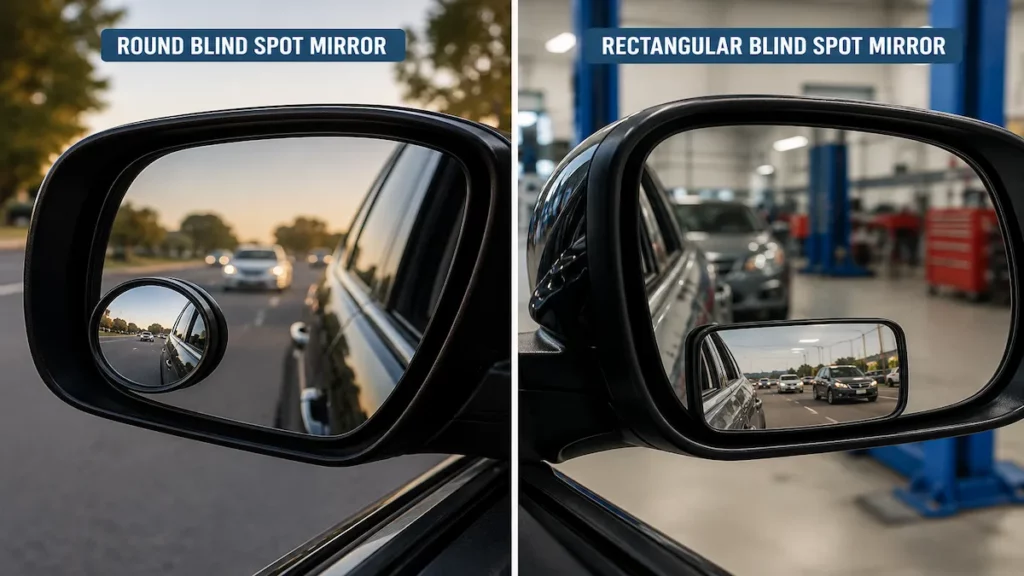
The best shape depends less on marketing and more on what you drive and what problem you want the mirror to solve.
Round blind spot mirrors
Round mirrors are the most common style for a reason. They are compact, easy to place and usually suit smaller side mirrors without taking up too much room. For everyday cars, round mirrors are often the safest choice because they add visibility without dominating the mirror surface.
They are a particularly good fit if your main goal is general lane-change awareness rather than maximum coverage. On a hatchback or saloon, a good round mirror can be all you need.
Oval blind spot mirrors
Oval mirrors sit somewhere in the middle. They usually give a bit more width than a round mirror while still looking fairly neat on the side mirror. They can be a good compromise if you want slightly more coverage but don’t want to jump to a larger rectangular design.
For some SUVs and crossovers, an oval mirror makes sense because it provides a little more visual range without feeling oversized.
Rectangular or wedge-style blind spot mirrors
Rectangular blind spot mirrors are often marketed as the best option for SUVs, trucks and vans because they can show a broader slice of the adjacent lane. That can be true, but they need to be chosen carefully. A long rectangular mirror can be very helpful on a large side mirror, but it can look ridiculous and feel intrusive on a smaller one.
This is one of those areas where real-world use matters more than generic advice. I’ve seen rectangular mirrors work brilliantly on larger vehicles that genuinely have more blind area to cover.
I’ve also seen cheap oversized ones ruin the usability of perfectly decent factory mirrors. If you drive a bigger vehicle and want a broader view for motorway use, rectangular can make sense. If you drive a compact car, it usually isn’t the first style I’d choose.
How to Choose Blind Spot Mirrors
his is the section most people actually need, because the biggest buying mistake is assuming all blind spot mirrors are basically the same. They are not. Some are clear and useful. Some are badly distorted, poorly made and not worth sticking on your mirror.
Start with the vehicle, not the product listing
A blind spot mirror that works nicely on a small hatchback may not be the best choice on a large SUV or van. Your factory mirror size matters. Your seating position matters. The shape of the vehicle matters. A tiny round mirror on a tall, wide vehicle may not cover enough useful area, while a large rectangular mirror on a compact car can feel like visual clutter.
If you drive a hatchback, saloon or smaller crossover, a compact round or oval mirror is usually the sensible place to start. If you drive a larger SUV, ute or van, you may want a slightly larger round mirror or a slim rectangular design if your side mirrors are large enough to accommodate it without blocking too much of the main view.
Decide what you want the mirror to help with
This sounds obvious, but it changes the buying decision more than most people realise.
If you mainly want lane-change visibility, choose a mirror that gives a clean view of the adjacent lane without taking up too much space. A compact round or oval mirror often works well for this.
If you mainly want parking visibility, you may prefer a mirror or position that lets you see lower down toward the rear wheel, kerb or parking line. That can make a slightly different size or shape more useful.
If you want both, you need a sensible compromise. That usually means a medium-sized mirror with decent adjustability rather than the biggest thing you can stick on the glass.
Prioritise glass quality over gimmicks
Blind spot mirrors are cheap enough that a lot of listings lean heavily on marketing fluff. “360-degree visibility”, “HD wide angle”, “ultra-clear anti-glare” and so on. Some of that is fine, but the basics matter more.
You want a mirror with clear glass, minimal distortion and decent weather resistance. Poor-quality mirrors often go hazy, scratch easily or create such a fish-eye effect that you stop trusting what you’re seeing. That is the opposite of what a safety accessory should do. If the image feels unreliable, the mirror stops being helpful.
Adhesive quality matters more than people think
This is one of the least glamorous but most important parts of the buying decision. A blind spot mirror lives outside in heat, rain, UV, vibration and regular washing. Weak adhesive means it can peel off, shift position or start rattling. I’ve seen cheap stick-on accessories fail simply because the adhesive backing was never up to the job.
Look for automotive-grade adhesive or at least a product with a decent reputation for staying put. I would rather buy a simple mirror with reliable adhesive than a fancy design that starts wobbling after a few weeks.
Be careful with oversized mirrors
A larger mirror can be useful on a large vehicle, but oversized blind spot mirrors are one of the easiest ways to ruin your main mirror view. If the accessory starts taking over the factory mirror, you are creating a different visibility problem. It is much better to choose a slightly smaller mirror that you can trust and position properly than a giant one that tries to do everything and ends up doing too much.
Check for compatibility with modern blind spot warning lights
If your car already has blind spot monitoring with a warning light built into the side mirror, pay attention to placement and mirror size. A badly placed aftermarket blind spot mirror can partially block that warning light, which defeats the point of having both systems. In those cases, smaller round mirrors or carefully positioned adjustable mirrors tend to make more sense than large rectangular ones.
Common Blind Spot Mirror Mistakes to Avoid
The first mistake is buying the cheapest mirror available without thinking about optics, adhesive or size. Because blind spot mirrors are inexpensive, people often treat them as disposable and just grab the first thing with decent reviews. That is how you end up with mirrors that distort badly, scratch easily or fall off in hot weather.
The second mistake is choosing the biggest mirror possible because it sounds safer. Bigger only helps if it still leaves the main side mirror usable. Oversized blind spot mirrors often feel cluttered and can block the exact view you still need from the standard mirror.
The third mistake is sticking them on without testing the angle first. Placement changes everything. A mirror installed in the wrong spot may just duplicate what the main mirror already shows. At that point, it is not solving the problem you bought it for.
The fourth mistake is using them instead of learning proper mirror setup. Blind spot mirrors work best when the factory mirrors are already adjusted sensibly. If your side mirrors are aimed mostly at your own car, a blind spot mirror is just masking the underlying issue.
The last mistake is trusting them too much. They are a useful aid, not a replacement for proper observation. You still need to use indicators properly, keep scanning the road and check over your shoulder when needed.
Blind Spot Mirrors Comparison Guide
| Vehicle Type | Recommended Mirror Type |
|---|---|
| Compact Car | Small Round Mirror |
| SUV | Rectangular Frameless |
| Pickup Truck | Large Adjustable Mirror |
| Van | Wide-Angle Adjustable |
| Towing Vehicle | Adjustable Convex Mirror |
Blind Spot Mirrors vs Electronic Blind Spot Monitoring
If your car already has electronic blind spot monitoring, you might wonder whether blind spot mirrors are still worth fitting. Sometimes yes, sometimes no.
Blind spot monitoring systems are useful because they warn you when something is in the adjacent lane, but they do not always tell you much beyond that. A warning light can let you know a vehicle is there, but it does not show you its exact position, speed or how close it is to your rear quarter. A blind spot mirror gives you visual context, which some drivers still prefer.
On the other hand, if you already have a good blind spot monitoring system, your mirrors are adjusted well and you are happy with your visibility, you may not feel any need to add aftermarket mirrors. This is one of those cases where the answer depends more on the vehicle and the driver than on a universal rule.
Final Thoughts
Blind spot mirrors are one of the cheapest visibility upgrades you can add to a car, but they only feel useful when the size, shape and placement actually suit the vehicle. Buy a cheap oversized mirror, stick it on without testing the angle and expect it to replace proper mirror checks, and you will probably end up wondering what the fuss was about.
If you choose a well-made glass mirror, keep the size sensible and fit it to solve a specific problem such as lane-change visibility or parking confidence, they can be surprisingly helpful. For older cars, larger SUVs, vans and drivers who simply want a better view of what is happening beside the vehicle, blind spot mirrors are still one of the simplest low-cost upgrades worth considering.
If you’re trying to improve overall visibility and safety rather than just add one accessory, it’s also worth looking at a few related upgrades. A good car emergency kit is still worth keeping in the boot for roadside problems, and if you want to build out a more complete everyday safety setup, our guide to essential car safety gadgets is a good next read. If you’re fitting accessories because you’re trying to make the car feel safer in general, not just easier to see out of, our breakdown of car anti-theft devices may also help.
Frequently Asked Questions
Where is the best place to put blind spot mirrors?
For most drivers, the outer lower corner of the side mirror is a good starting point because it adds extra visibility without blocking too much of the main mirror. Some drivers prefer the outer upper corner for lane-change visibility. The best placement depends on what you want the mirror to show and how your standard mirrors are already adjusted.
What size blind spot mirror should I buy?
A 2-inch blind spot mirror is a good starting point for most cars. Larger vehicles such as SUVs, utes and vans may benefit from a slightly bigger mirror, but bigger is not always better if it blocks too much of the factory mirror.
Are blind spot mirrors good for parking?
Yes. A properly positioned blind spot mirror can make it easier to see kerbs, parking lines and the rear wheel area when manoeuvring. For some drivers, parking visibility is actually the biggest benefit of fitting them.
Do blind spot mirrors really reduce blind spots?
They can reduce the hidden areas around the side of the vehicle by widening the field of view, but they do not completely remove every blind spot. They should be used alongside proper mirror adjustment and normal shoulder checks.
Are adjustable blind spot mirrors better than fixed ones?
Usually yes. Adjustable blind spot mirrors let you fine-tune the viewing angle for your vehicle, seating position and intended use. Fixed mirrors can still work well, but only if the placement and angle happen to suit you perfectly.
Can blind spot mirrors damage side mirrors?
Not normally if they are fitted and removed carefully. The biggest issue is usually adhesive residue rather than actual glass damage. If you ever remove them, warming the adhesive slightly first tends to make the process easier and cleaner.
Should I use blind spot mirrors if my car already has blind spot monitoring?
You can, but you may not need to. Electronic blind spot monitoring gives you a warning, while a blind spot mirror gives you a wider visual view. Some drivers like having both, while others are perfectly happy with the factory system alone.
Do blind spot mirrors replace proper mirror adjustment or a shoulder check?
No. Blind spot mirrors should be treated as a supplement to good driving habits, not a substitute for them.