
TL;DR: What is a Essential Off Road Car Accessories
The best off-road car accessories are the ones that reduce risk, prevent vehicle damage, and improve recovery and self-sufficiency when driving in remote or difficult terrain. Recovery gear, tyre pressure tools, underbody protection, communication devices, and navigation systems are the most important categories because they directly prevent breakdowns, stuck situations, and costly repairs.
The reality is that successful off-roading isn’t about how much power your vehicle has. It’s about preparation. The best off-road car accessories help solve the real problem drivers face when they leave sealed roads:
How do you remain safe, mobile and self-sufficient when help may be hours away? That question should guide every accessory purchase you make.
Off-road accessories are not about upgrading a vehicle for looks or status. They are about reducing predictable risks that become expensive when things go wrong.
This guide explains which off-road accessories genuinely improve capability, safety, and reliability, while helping drivers avoid wasting money on upgrades that provide little real-world value.
What is Inside? (Quick Glance)
Why Most People Buy the Wrong Off-Road Accessories
Many people believe successful off-roading starts with buying a capable four-wheel drive. In reality, capability is only part of the equation.
Over the years, I’ve seen vehicles arrive at workshops after off-road trips with damaged oil pans, punctured tyres, electrical failures, and expensive recovery bills. Surprisingly, many of these vehicles were highly capable models with plenty of power and sophisticated four-wheel-drive systems.
The problem wasn’t the vehicle. The problem was preparation. A modern off-road vehicle can only perform as well as the equipment supporting it. The right accessories help you recover from difficult situations, protect vulnerable components, improve traction, and stay safe when you’re far from assistance.
The wrong accessories often do little more than add weight, cost, and complexity.
That is why choosing the best off road car accessories isn’t about creating the most impressive-looking build. It is about reducing risk and increasing your chances of getting home without damage, delays, or expensive repairs.
Before spending money, it helps to understand what actually causes most off-road problems.
What Causes Most Off-Road Failures?
One thing I’ve noticed after years working on vehicles is that off-road failures are surprisingly predictable. Most problems fall into one of four categories.
- The first is loss of traction. Soft sand, mud, loose gravel, and steep terrain can stop even powerful vehicles if tyres and recovery equipment are inadequate.
- The second is impact damage. Rocks, washouts, hidden stumps, and uneven terrain can damage critical components underneath the vehicle.
- The third is mechanical or electrical failure. Remote travel puts additional stress on batteries, cooling systems, suspension components, and tyres.
- The fourth is isolation. A minor issue that would be easily solved in town can become a major problem when there is no phone reception and assistance is hours away.
When viewed this way, the purpose of off-road accessories becomes much clearer. The best accessories are those that directly reduce one or more of these risks.
Off Road Accessories Must Haves
1. Recovery Gear (Top Rated Off Road Car Gear)
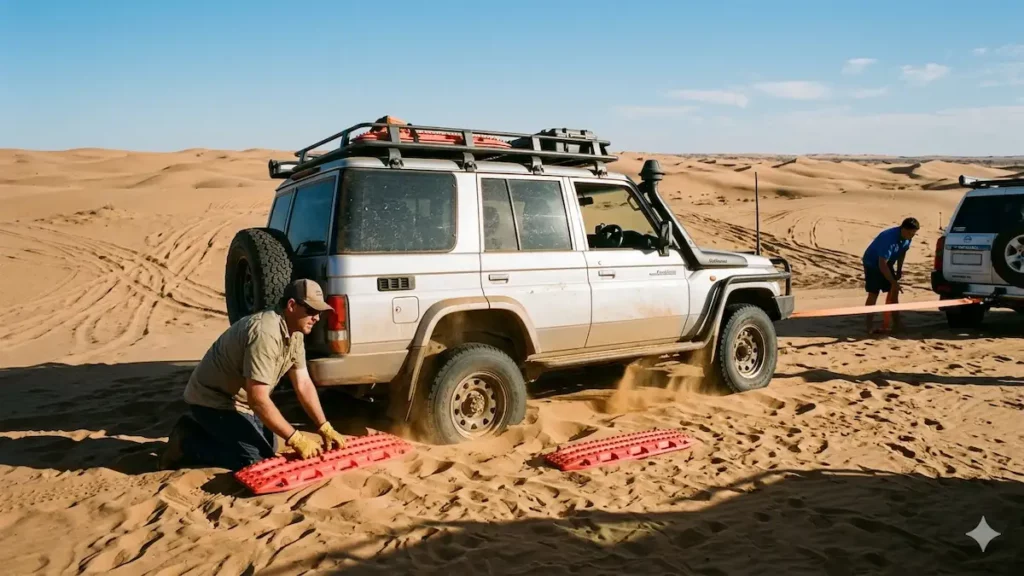
If I had to recommend only one category of off-road accessories to a beginner, recovery gear would be at the top of the list. The reason is simple. Getting stuck is not unusual when driving off-road. In fact, it is almost inevitable at some point.
I’ve seen drivers invest thousands in modifications while carrying little or no recovery equipment. Unfortunately, when the vehicle becomes bogged, all those expensive upgrades suddenly become irrelevant.
A customer once brought in a Toyota Hilux after a beach trip. The vehicle had plenty of power, quality tyres, and several cosmetic upgrades. What it didn’t have was a recovery kit.
After becoming bogged in soft sand, the driver spent hours waiting for assistance that could have been avoided with basic recovery equipment. That experience highlights an important lesson.
Off-road capability is not about avoiding every mistake. It is about being prepared when mistakes happen. A proper recovery kit should include:
- Recovery straps
- Rated shackles
- Recovery boards
- Recovery gloves
- Snatch block (for winch users)
- Recovery dampener
- Winch where appropriate
The goal is not to prepare for extreme situations. The goal is to prepare for common situations because common situations are what leave most people stranded.
Check your recovery setup with our guide
Want to avoid costly mistakes on your next trip?
2. All-Terrain Tyres
One of the biggest mistakes beginners make is focusing on visible modifications while overlooking the only part of the vehicle that actually touches the ground.
In workshop vehicles I’ve inspected after off-road trips, tyre choice often explains why one vehicle struggled while another completed the same track without difficulty.
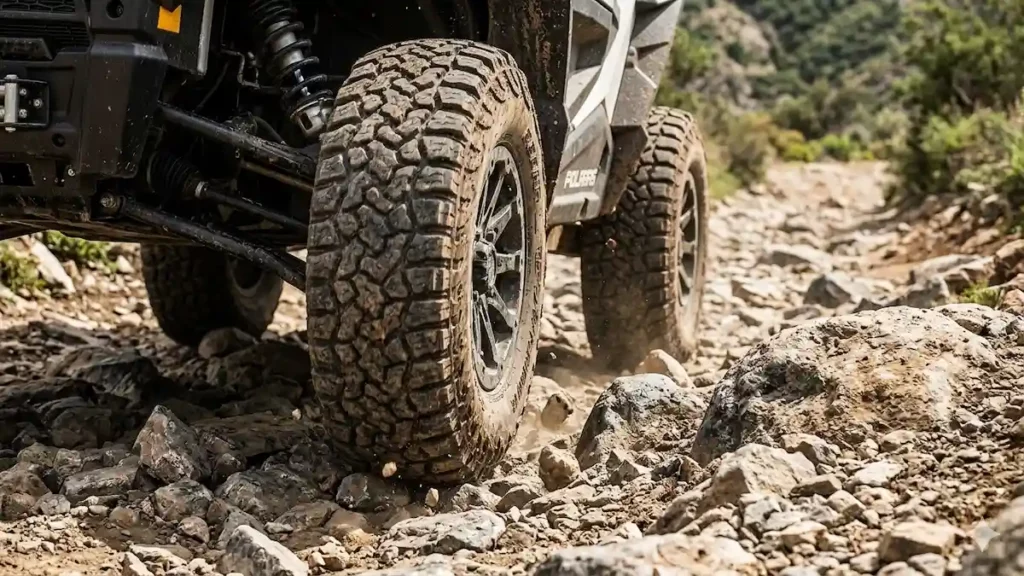
All-terrain tyres remain one of the best upgrades for drivers who split their time between sealed roads and off-road tracks. They offer improved grip, stronger construction, and greater resistance to punctures than standard road tyres.
For more demanding terrain, some drivers move towards more aggressive mud-terrain options, although these usually involve trade-offs in road noise and fuel economy.
The key is choosing tyres that match how the vehicle is actually used. One common mistake is buying the most aggressive tyre available simply because it looks impressive.
In reality, many drivers would be better served by a quality all-terrain tyre that provides balanced performance across a wider range of conditions. A tyre upgrade may not be the most exciting purchase, but it is often one of the most effective.
3. Off-Road Lighting
Night driving off-road presents challenges most road drivers never encounter. Wildlife, washouts, fallen branches and unexpected obstacles can appear with little warning. Factory headlights are designed primarily for road use.
Off-road lighting systems extend visibility and improve reaction time. Popular options include:
LED Light Bars
Provide broad forward illumination and excellent coverage.
Spotlights
Designed for long-distance visibility.
Particularly useful on open tracks and remote roads.
Flood Lights
Ideal for campsites, recovery situations and close-range visibility.
Good lighting isn’t about appearance. It’s about giving yourself more time to identify hazards before they become problems.
4. Underbody Protection (Skid Plates)
One of the most costly types of off-road damage happens where drivers cannot easily see it. Oil pans, transmission housings, fuel lines, and steering components are often exposed enough to be vulnerable in rough terrain.
In workshop inspections after off-road trips, underbody damage is one of the most common reasons for unexpected repair bills.
What makes it frustrating is that many of these failures happen at relatively moderate speeds or over terrain that didn’t look dangerous.
Skid plates and underbody protection don’t improve performance in the traditional sense. They reduce the consequence of unavoidable impacts.
Rocks don’t care about your oil pan. One SUV came in with a cracked oil sump after hitting a rock. No skid plate. That single mistake turned into a full engine repair job.
5. Navigation & Communication Tools
The further you travel from populated areas, the more important communication becomes.
Mobile coverage is unreliable in many off-road environments. GPS alone is not always enough if conditions change or routes become unclear. This is where dedicated navigation tools and communication devices matter.
UHF radios, offline mapping systems, and satellite communication devices provide a safety net when things don’t go as planned. The real value is not convenience. It is time. Time to get help. Time to correct a route. Time to respond to unexpected situations.
Learn more about off-road navigation safety:
https://www.nps.gov/media/article-search.htm
6. Dual Battery System
Modern off-road adventures often involve much more than driving. Camping refrigerators, lighting systems, portable charging stations, air compressors, GPS units, and communication equipment all place demands on a vehicle’s electrical system.
The problem is that every accessory drawing power increases the risk of flattening the starter battery. In workshop vehicles used for touring and remote travel, flat batteries are one of the most common preventable issues.
Drivers spend the evening running accessories comfortably, only to discover the vehicle won’t start the following morning. A dual battery system solves this problem by separating accessory power from starting power.
The primary battery remains reserved for vehicle operation, while the secondary battery supports additional equipment. For occasional weekend trail use, a dual battery system may not be necessary.
For extended touring, camping, or remote travel, it can quickly become one of the most valuable upgrades on the vehicle.
The decision should be based on how you actually travel rather than what looks impressive on social media.
7. Portable Air Compressor
Most drivers understand the importance of tyres. Far fewer appreciate the importance of tyre pressure.
Lowering tyre pressure increases the tyre’s contact patch, allowing it to conform more effectively to uneven terrain. This can significantly improve traction in sand, mud, and rocky conditions.
Once the off-road section is complete, those tyres need to be returned to suitable road pressures. This is where a portable air compressor becomes essential. Many people view air compressors as convenience items. I see them as problem-prevention tools.
Without one, drivers often continue travelling on incorrect tyre pressures, which can increase tyre wear, reduce handling stability, generate excess heat, and increase the likelihood of tyre failure.
For relatively little cost, a quality compressor provides flexibility across multiple terrain types while helping protect a much larger investment in tyres. Widely recommended by off-road experts and enthusiasts (Adventure).
8. Snorkel
Many people believe snorkels are only useful if you regularly drive through deep water. While a snorkel does raise the engine’s air intake and can help reduce the risk of water ingestion during water crossings, it also provides benefits in dusty environments.
On outback tracks and dry trails, dust can be a significant issue. By relocating the air intake higher on the vehicle, a snorkel often allows the engine to draw cleaner air compared with the standard intake location.
However, snorkels are not magic solutions. Installing one does not make a vehicle waterproof. Electrical systems, differentials, gearboxes, wheel bearings, and numerous other components remain vulnerable to water exposure.
One of the most expensive mistakes I’ve seen is drivers assuming a snorkel makes deep water crossings risk-free. It doesn’t. A snorkel should be viewed as part of a broader vehicle protection strategy rather than a standalone solution.
Off Road Vehicle Accessories Comparison
| Accessory | Best For | Key Benefit |
|---|---|---|
| Recovery Tracks | Sand/Mud | Instant traction |
| Recovery Kit | Emergencies | Complete safety gear |
| Winch | Extreme recovery | Pull vehicle out |
| LED Light Bar | Night driving | Better visibility |
| Air Compressor | Tire control | Better traction |
| Roof Rack | Storage | Carry more gear |
| Snorkel | Water crossings | Engine protection |
Common Off-Road Accessory Buying Mistakes
Many off-road enthusiasts waste money not because they buy poor-quality products, but because they buy the wrong products first. One of the most common mistakes is prioritising appearance over function.
Large lighting setups, elaborate roof systems, and expensive cosmetic modifications often appear before basic recovery equipment has even been purchased.
Another frequent mistake is failing to match accessories to actual driving conditions. A vehicle primarily used for beach driving has very different requirements from one regularly tackling rocky mountain tracks.
Copying another person’s build is rarely a good strategy because their needs may be completely different.
Cheap equipment is another area where problems frequently occur. Recovery gear, in particular, should never be selected purely on price. When recovery equipment fails under load, the consequences can be severe.
- Quality matters.
- Certification matters.
- Reliability matters.
Saving money on critical safety equipment often becomes expensive later.
How to Choose the Best Off Road Car Accessories for Your Driving Style
The most effective accessory setup depends entirely on how the vehicle is used. Drivers who spend most of their time on beaches should prioritise tyre pressure management, recovery boards, and compressors because traction loss is the primary challenge.
Those exploring rocky tracks should focus on underbody protection, tyre durability, and recovery equipment because impact damage becomes a greater risk.
Mud driving places heavy emphasis on traction aids and recovery systems due to constantly changing surface conditions. Long-distance touring requires a different approach altogether. Reliability becomes more important than outright capability.
Dual battery systems, communication equipment, navigation tools, storage solutions, and recovery gear generally provide the greatest value for travellers covering large distances.
Before purchasing any accessory, ask a simple question: “What specific problem does this solve for my style of driving?” If the answer is unclear, the accessory may not deserve a place on the vehicle.
Off Road Car Accessories Buying Guide: How to Choose Off Road Car Accessories
Before spending money, take a moment to evaluate the purchase carefully. Ask a few questions to identify the appropriate accessorries.
Does this accessory solve a genuine problem? Will it be used regularly? Does it improve safety, recovery, reliability, or protection? Is it compatible with the vehicle? Will it add significant weight? Will it require ongoing maintenance? Can the money be better spent elsewhere?
These questions help prevent impulse purchases and encourage smarter long-term decisions. The best off-road setups are rarely built quickly. They evolve over time as drivers gain experience and better understand their needs.
The Best Upgrade Order for Beginners
New off-road enthusiasts often ask which accessory should be purchased first. The answer usually surprises them.
Tyres and recovery equipment generally provide greater practical benefits than many expensive modifications.
For most drivers, a sensible progression looks like this: First, invest in recovery equipment. Second, improve tyre capability and tyre pressure management. Third, add underbody protection if the terrain justifies it. Fourth, improve communication and navigation systems. Fifth, consider touring and convenience upgrades such as dual battery systems and storage solutions.
This order focuses on reducing risk before adding comfort or appearance-based modifications. It is also the order that tends to deliver the greatest real-world value.
Pro Tips for Off-Road Adventures
- Always carry recovery gear before heading off-road
- Lower tire pressure for sand and increase for highways
- Never go off-roading alone without safety tools
- Test all equipment before your trip
Final Thoughts
Off-road driving places far greater demands on a vehicle than normal road use. While a capable 4WD is important, the right accessories often determine whether a trip remains enjoyable or turns into an expensive recovery operation. Recovery equipment, tyre management tools, underbody protection and navigation systems are among the most valuable upgrades for both beginners and experienced off-road enthusiasts.
The best off road car accessories are not necessarily the most expensive, the most popular, or the most impressive looking.
They are the accessories that reduce risk, improve reliability, and help solve problems before those problems become expensive recoveries or repairs.
Throughout my years working on vehicles, one lesson has remained consistent: most off-road failures are preventable.
Drivers often focus on horsepower, suspension lifts, and appearance upgrades, while overlooking the equipment that actually keeps them moving when conditions become difficult.
Recovery gear, quality tyres, tyre pressure management tools, communication systems, and vehicle protection consistently deliver the greatest real-world value because they address the situations off-road drivers face most often.
If you’re building an off-road vehicle, start with preparation rather than appearance. The vehicle that gets home safely is always more impressive than the one that simply looks capable.
Frequently Asked Questions
What are the most important off-road accessories for beginners?
Recovery gear, all-terrain tyres, tyre pressure management tools, and communication equipment are typically the most important starting points because they directly address the most common off-road challenges.
Do I need a winch for off-roading?
Not always. Many drivers can safely enjoy off-road travel with recovery boards, straps, and proper recovery techniques. A winch becomes more valuable in remote or difficult terrain where self-recovery options are limited.
Are all-terrain tyres worth the investment?
For most off-road drivers, yes. They improve traction, durability, and puncture resistance while maintaining acceptable road manners for daily driving.
Is a snorkel necessary?
Only if your driving conditions justify it. Snorkels can help during water crossings and dusty conditions, but they are not essential for every driver.
How much should I budget for essential off-road accessories?
Costs vary significantly, but prioritising recovery gear, quality tyres, tyre pressure management equipment, and basic protection often provides the best return on investment before considering more specialised upgrades.
Hi,it’s very useful
I’m not deeply into off-roading (yet), but it’s something I’ve been curious about, especially the idea of exploring more remote places. At the same time, I’ll admit, I’d probably be the kind of person who underestimates the terrain and overestimates the vehicle. So, your real-life examples, especially the Hilux getting stuck in the sand, really hit home. It made everything feel a lot more real and not just theoretical advice.
If I were to start small and just build up gradually, what would you personally prioritize first, recovery gear or tires? And is there one mistake you see beginners make over and over that we should really try to avoid?
Thanks so much, Celia! That’s a great question. I’d personally prioritize recovery gear first, it’s cheaper, practical, and can save you quickly if things go wrong. Tires are important too, but you can upgrade those as you get more serious. One common mistake beginners make is going off-road alone without proper gear or planning. It’s always safer to start small, go with others, and be prepared.
Hope that helps, and enjoy the adventure when you start!
Very useful thankyou
Thank you very much for your feedback.