
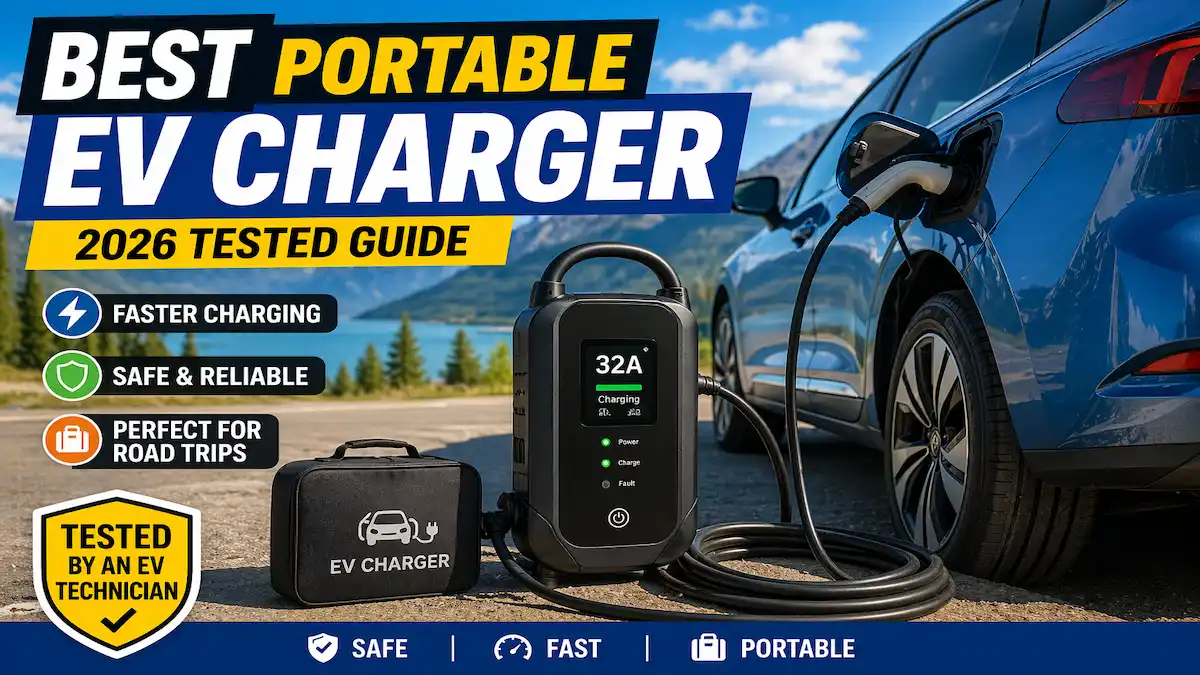

TL;DR: What is a Best Portable EV Chargers
The best portable EV chargers are the ones that match how you actually charge, not just the ones with the biggest amp number on the box. For most EV owners, a good portable charger should be safe, weather-resistant, compatible with your car’s plug type, and flexible enough to work as a home backup or travel charger. If you already have a wall charger at home, a portable unit is usually worth buying as emergency kit. If you do not have home charging yet, the right portable charger can also serve as a temporary everyday solution, provided you understand its speed limits and outlet requirements.
Buying a portable EV charger sounds simple until you actually start comparing them. On paper, most of them look similar. You will see a lot of claims about 7kW charging, adjustable current, waterproof casings, smart apps and universal compatibility.
Then the deeper questions start creeping in. Will it actually charge your EV at a decent speed from a normal socket? Is it safe to use regularly? Can it stay in the boot as an emergency backup without becoming dead weight? If you buy a cheaper one now, will you regret it after the first road trip or after the first time it has to charge outdoors in the rain?
That is where most “best portable EV charger” guides fall short. They list products, repeat the spec sheets and move on. Real buyers are not just trying to compare charging cables. They are trying to avoid wasting money on the wrong charger, avoid getting stranded with an EV they cannot top up properly, and avoid buying something that looks versatile but turns out to be awkward, slow or questionable from a safety point of view.
What’s Inside? (Quick Glance)
Why a portable EV charger is worth having
A portable EV charger is basically insurance for your charging plan. If you already have a good home setup and mostly drive locally, you may not use it often. But the value is not measured by how many times you plug it in every month. The value is in the situations where it saves you from a bigger headache.
Road trips are the obvious example. A public charger that is out of service, fully occupied or simply slower than expected can throw off the rest of your day. Having a portable charger gives you another option if you are staying somewhere overnight and have access to power. It will not replace rapid charging on the highway, but it can turn a charging problem into a manageable overnight top-up instead of a stressful search for another charger late in the evening.
The same goes for visiting family, staying in regional accommodation or keeping the car charged while waiting for a home wall charger to be installed. A portable charger is also useful for drivers who want a backup in the car at all times, especially if they regularly travel outside major metro areas where charging infrastructure is less predictable.
From a workshop mindset, this is the same logic as carrying a decent tyre inflator, jump starter or emergency tool kit. You do not buy it because you plan to use it every week. You buy it because the one time you need it, you really do not want to be without it.. Loose-fitting connectors or poorly manufactured plugs can create long-term reliability concerns.
Check here for EV charging standards and safety:
https://www.energy.gov/eere/electricvehicles/charging-electric-vehicles
What actually makes a good portable EV charger?
Portable EV chargers are easy to compare badly because the spec sheets can make them all look similar. A lot of listings focus heavily on amperage, app features or “fast charging” claims, but that is only part of the story.
The first thing that matters is charging level and output. For most EV owners, the sweet spot is a portable Level 2 charger rather than a very basic Level 1-only unit. Level 1 charging from a normal household socket can still be useful as a slow emergency option, but if you want a portable charger that is genuinely practical for travel and home backup charging, Level 2 is where the value starts to improve.
The second thing is build quality. This matters more than many buyers realise. Portable chargers get moved around, coiled up, left in boots, plugged in outdoors and occasionally dragged between different properties. A flimsy cable, weak plug head or poorly protected control box might not show its weaknesses on day one, but it often does once it has had a bit of real use. Thick cable insulation, solid connectors and a properly sealed control unit are worth paying attention to.
The third thing is safety protection. This is not an area to treat casually. A good portable charger should have built-in protection against overheating, overcurrent, voltage irregularities and ground faults. If a charger listing is vague about certification or seems more interested in marketing than safety details, that is a warning sign.
The fourth thing is compatibility. That includes both your EV’s charging connector and the outlet you expect to use most often. In Australia and many other markets, Type 2 compatibility is the main consideration for a lot of EVs, but buyers still need to check carefully because outlet type and adapter availability can change how useful a charger actually is on the road.
Finally, there is practical portability. Some chargers are technically portable but still bulky enough that you will think twice about carrying them around regularly. Others are much easier to store in the boot, which makes them more likely to be there when you need them.
Portable EV Charger Comparison
| Charger Type | Power Source | Charging Speed | Best Use Case | Pros | Cons |
|---|---|---|---|---|---|
| Level 1 (Portable Basic) | Standard 120V wall outlet | Slow (8–10 km/hour) | Emergency use, overnight backup | No installation needed Works anywhere | Very slow Not practical for daily use |
| Level 2 (Best Portable EV Charger Option) | 240V outlet | Medium–Fast (25–40 km/hour) | Home charging, road trips | Faster charging Reliable for daily use Ideal balance of speed & portability | May require proper outlet Slightly more expensive |
| DC Fast Charger (Public) | High-voltage DC supply | Very Fast (150–300+ km/hour) | Highways, long-distance travel | Rapid charging Ideal for quick top-ups | Expensive Not portable Battery wear over time |
| Smart Portable Charger | 120V / 240V (varies) | Depends on amperage | Tech-savvy users, energy tracking | App control Scheduling Energy monitoring | Higher cost Not always necessary |
| Solar EV Charger (Portable/Hybrid) | Solar panels + battery | Very slow (varies widely) | Off-grid situations | Eco-friendly Works without grid power | Extremely slow Weather dependent |
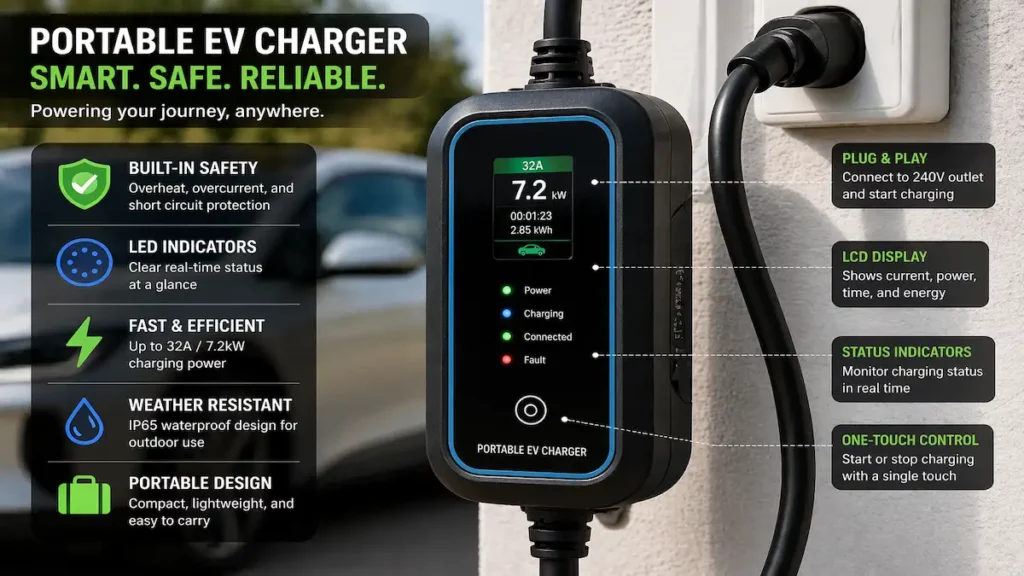
Best portable EV chargers worth considering
1. Best portable EV charger for Tesla owners: Tesla Mobile Connector
For Tesla owners, the Tesla Mobile Connector is still one of the easiest portable charger recommendations to make.
The biggest reason is simplicity. It is designed to work neatly within Tesla’s own ecosystem, it is compact enough to keep in the car, and it is intended exactly for the sort of backup and travel use most owners want from a portable charger. If you drive a Tesla and want something you can rely on for overnight charging away from home or for emergency backup, it makes a lot of sense.
Another advantage is that it covers the role a portable charger should cover without pretending to be something else. Tesla itself treats the Mobile Connector as a flexible, portable solution rather than the ideal permanent home charging setup, and that is the right way to think about it. It is there for travel, convenience and backup charging, not to replace a dedicated home wall charger if you are doing heavy weekly mileage and want the fastest overnight charging possible.
Where it makes the most sense is for Tesla owners who want a charger they can leave in the boot and forget about until needed. It is compact, proven and easy to live with, which is exactly what a backup charger should be.
Best for: Tesla owners wanting a reliable travel and backup charger.
Watch out for: buyers expecting it to be the fastest possible full-time home charging solution.
2. Best premium portable EV charger for road trips and serious flexibility: J+ Booster 2
If the Tesla Mobile Connector is the simple, easy answer for Tesla owners, the J+ Booster 2 is the charger for drivers who want a more heavy-duty portable solution with better flexibility across different charging situations.
This charger has built a strong reputation because it is aimed at people who use portable charging for more than the occasional emergency. It is the sort of unit that makes sense if you travel regularly, use different outlet types or want a portable charger that can double as a serious backup home charging option. The ability to adapt to multiple power sources is a big advantage if you are the kind of driver who stays in regional accommodation, visits different properties or just wants one charger that can cover more than one scenario.
It is also one of the better options if you care about durability. That matters because portable chargers live a harder life than wall-mounted home chargers. They get moved around, stored, packed and used in less predictable conditions. A charger built with travel and outdoor use in mind is worth paying for if you know it is going to be used properly rather than just kept in the car “just in case”.
The main drawback is price. It is not the charger I would point to for somebody who just wants a cheap emergency backup to use twice a year. But if you want one portable charger that feels like a proper long-term piece of EV kit rather than a compromise, it deserves a place on the shortlist.
Best for: frequent road-trippers, mixed-use charging and drivers wanting a more premium portable setup.
Watch out for: the higher upfront price if your usage will be very occasional.
3. Best rugged portable EV charger for mixed use: Grizzl-E Mini
The Grizzl-E Mini sits in a nice middle ground for drivers who want something more substantial than a basic backup charger but do not necessarily want to jump straight to premium pricing.
Its appeal is that it is still portable enough to keep in the vehicle, but it feels more like a serious charger than a simple emergency cable. That makes it attractive for owners who want a charger they can use at home from time to time, keep in the boot for travel, and generally rely on a bit more often than just once in a blue moon.
This is the sort of charger that suits drivers who want flexibility without going overboard. If you split time between locations, take longer trips or simply want something sturdier than the cheaper marketplace options, it makes sense. It is also one of the more sensible picks for drivers who do not want to treat portable charging as a last-resort backup only.
The key thing here is balance. A charger like the Grizzl-E Mini makes sense when you want portability and regular usefulness, not just a cheap emergency fix.
Best for: non-Tesla owners wanting a sturdier all-round portable charger.
Watch out for: whether its size, cable setup and outlet compatibility suit how you actually plan to use it.
4. Best budget portable Level 2 charger: Lectron portable charger
Lectron tends to show up in portable EV charger discussions because it offers a more affordable route into Level 2 charging without dropping straight into the no-name bargain end of the market.
That matters because portable chargers are one area where going too cheap can be a false economy. A low-cost charger that overheats, charges inconsistently or feels questionable after a few months is not really a bargain if you stop trusting it. Lectron sits in that middle space where the pricing is more accessible, but you are still looking at a recognisable EV charging brand rather than a random generic listing.
The value of a charger like this is that it can make sense for drivers who want something faster and more useful than a basic Level 1 travel charger but are not ready to spend premium money. If you want a portable Level 2 charger for occasional home use, road trips or backup charging, it is worth considering.
The usual caution applies, though. With mid-priced chargers, I would still pay close attention to warranty support, certification and what real owners say about long-term reliability. Portable EV charging is not an area where I would buy purely on the cheapest price tag.
Best for: buyers wanting a more affordable Level 2 portable charger from a known EV charging brand.
Watch out for: support quality and long-term durability compared with more premium options.
How to choose the right portable EV charger for your needs
The best way to avoid buying the wrong portable charger is to stop asking “Which charger is best?” and start asking “Best for what?”
If the charger is mainly going to live in the boot as a backup, compact size, reliability and broad compatibility matter more than chasing the highest output. In that situation, the goal is to have something dependable when your main charging plan falls apart.
If you expect to use the charger regularly at home, even if only temporarily, then charging speed and outlet compatibility become much more important. A charger that feels fine as an occasional emergency option may feel frustratingly slow or awkward if it becomes part of your weekly charging routine.
Travel habits matter too. If you regularly stay away from home, drive into regional areas or use accommodation where charging options vary, then adapter flexibility and build quality become much more valuable. A charger that can cope with different outlet situations is much more useful than one that only works neatly in one predictable setup.
It is also worth thinking about cable length. This is one of those small details that can become irritating very quickly. A charger may look ideal until you realise the outlet is on the wrong side of the garage, the parking space at your accommodation is awkward, or the car’s charging port location makes the cable stretch too far. Five to seven metres is usually a sensible range to aim for.
Finally, be realistic about your power supply. There is no point buying a high-output portable charger if the outlet you will use most often cannot support it. The charger may still work, but you are paying for capability you may never actually use.
For emergency prep, read:
https://pickyaura.com/ev-accessories-and-tools/prepare-ev-emergency-kit/
If you’re serious about avoiding breakdown stress, don’t wait until you need one. Check the tested recommendations here:
https://pickyaura.com/ev-accessories-and-tools/ev-charging-cables-tested/
Common portable EV charger mistakes to avoid
The first mistake is buying purely on price. I understand why people do it because EV ownership is not cheap, but portable chargers are not the kind of accessory where I would gamble on the absolute cheapest option. If the charger overheats, trips out repeatedly or feels unreliable, the money you saved disappears very quickly.
The second mistake is treating a portable charger like a guaranteed replacement for a proper home wall charger without thinking about charging speed. Some portable chargers can absolutely do useful home charging, but that does not mean every portable charger will suit every daily routine. If you drive a lot of kilometres every week, a slow portable setup may end up feeling like a compromise very quickly.
The third mistake is ignoring outlet compatibility. A charger can look perfect online and still be wrong for your actual home or travel setup if the plug type does not match the outlets you have access to. That is one of the simplest buying mistakes to avoid if you check before ordering.
The fourth mistake is overlooking build quality and weather resistance. A charger that will live in the car, be used on trips or charge outdoors needs to be treated differently from one that only ever gets plugged in inside a dry garage. Travel and outdoor use are harder on charging equipment than buyers often expect.
The fifth mistake is not testing the charger before relying on it for a road trip. This is a big one. If you buy a portable EV charger, use it at home first. Make sure the vehicle charges correctly, the outlet setup works, the cable reaches comfortably and nothing overheats or trips out unexpectedly. The worst time to discover a compatibility or reliability problem is when you are already away from home.
Final Thoughts
For most EV owners, yes, but not always for the reason they expect. A portable EV charger is rarely the most glamorous part of an EV setup. Its value is in reducing the number of situations where your charging plan falls apart. It gives you a fallback if home charging is unavailable, if public chargers are unreliable, or if you travel somewhere that has power but no dedicated EV charging hardware.
That kind of flexibility is worth a lot in real ownership. It is the same logic as carrying a decent tyre inflator or jump starter in the boot. You may not need it every week, but when you do need it, it can save you a lot of time, stress and money.
The only time I would say a portable charger is not worth buying is if your charging setup is already rock solid, your driving is extremely predictable and you genuinely never travel in ways that could benefit from backup charging. Even then, I would still argue there is a case for carrying one if you do longer trips or stay away from home with any regularity.
Frequently Asked Questions
Can a portable EV charger replace a home charging station?
For some drivers, yes. If daily driving distances are modest and charging time is available overnight, a portable charger may meet all charging requirements. Higher-mileage drivers often benefit from a dedicated wall charger.
Can I use a portable EV charger every day?
Yes, as long as the charger is designed for it, the outlet is suitable and the charger comes from a reputable brand with proper safety protection. Some EV owners use portable chargers regularly, especially while waiting for a home wall charger or if they do not have a permanent home charging setup.
How fast does a portable EV charger charge?
That depends on the charger, the outlet and the vehicle. Basic Level 1 charging from a household outlet is slow, while a Level 2 portable charger connected to a higher-capacity outlet can add range much faster. In real terms, a portable charger can range from “slow overnight top-up” to something much more practical for regular home backup charging.
Are portable EV chargers safe?
They are safe when they are well made, properly certified and used with a suitable outlet. This is why it is worth avoiding unknown low-cost chargers that do not clearly explain their safety protection or certification.
Do I really need a portable EV charger if I already have home charging?
Not every EV owner needs one, but it is still a smart backup if you do road trips, stay away from home or simply want a second charging option in the car. Think of it as charging insurance rather than a replacement for your main home setup.
As electric vehicles become more common, having the right charging solution is something many drivers will need to think about. I appreciate that you explained the options clearly, since it can be confusing for first-time EV owners. A portable charger seems like a smart backup for road trips or unexpected situations. Do you think most drivers should own one even if they already have a home charging setup?
Hi Monica, thank you for the question! While a dedicated home charger is best for daily, fast charging, a portable charger is excellent “insurance.” Even if you have a home setup, having a portable unit in your trunk gives you peace of mind for road trips, unexpected detours, or visiting friends and family who might not have a dedicated EV charger. It is the ultimate backup plan for any EV driver!