

TL;DR: What is a Car Emergency Kit
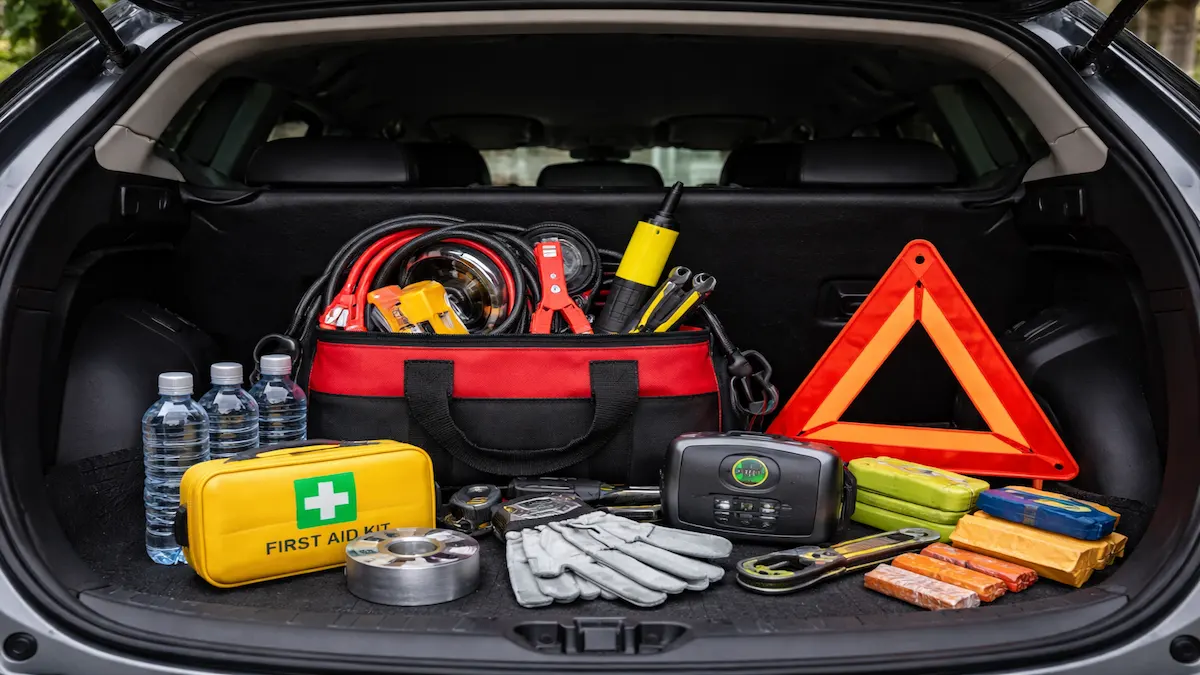
A car emergency kit is a compact collection of essential tools and safety supplies help you handle the roadside problems that happen most often. A proper car emergency kit should help you deal with the roadside problems drivers actually face, not imaginary survival scenarios. For most cars, that means carrying a portable jump starter or jumper leads, tyre inflator, warning triangle or LED beacon, torch, first aid kit, phone charger, water, gloves, and a few basic tools. If you do longer trips, travel with family, or drive in remote areas, your kit should also include extra water, snacks, weather gear, and supplies that help if you’re stuck waiting for assistance.
A car emergency kit is a collection of practical tools and supplies you keep in the vehicle to help with a breakdown, puncture, flat battery, roadside stop, or unexpected delay. On paper, that sounds obvious. In real life, it matters because most vehicle emergencies are not dramatic engine failures. They are the annoying, inconvenient, badly-timed problems that leave you stranded when you least expect it.
That’s the part many drivers underestimate. In workshop vehicles I’ve seen over the years, the roadside problem itself is often manageable. What makes it stressful is the lack of basic preparation.
So a car emergency kit is not just “extra gear for the boot”. It is part of sensible vehicle ownership. It sits in the same category as checking your tyres, replacing worn wipers, and keeping the battery healthy. You hope you won’t need it, but when something goes wrong, it can save time, money, and a lot of stress.
What is Inside? (Quick Glance)
What Should Be in a Car Emergency Kit?
If you only remember one part of this guide, make it this: a good car emergency kit is If you search for car emergency kit checklists online, you’ll find plenty of giant lists with twenty or thirty items thrown together. Some are useful. Some are filler. The smarter way to build a kit is to work backwards from the roadside problems you are actually likely to face.
A good car emergency kit should cover six basic jobs:
1) Help you restart the car if the battery goes flat
This is where a jump starter or jumper leads come in.
2) Help you deal with tyre trouble
That usually means a portable inflator, access to your spare wheel or tyre mobility kit, and ideally a pressure gauge.
3) Keep you visible and safer at the roadside
Reflective triangles, an LED emergency beacon, a hi-vis vest, and a decent torch all matter here.
4) Handle small injuries or minor personal emergencies
A basic first aid kit, gloves, wipes, and any family-specific medication are the important bits.
5) Keep your phone working so you can get help
A charging cable, 12V charger, or power bank is now part of roadside preparedness whether people think of it that way or not.
6) Help you wait safely if you’re stranded for a while
Water, snacks, an emergency blanket, and weather-appropriate extras matter more than people realise, especially on long trips.
Once you look at it through that lens, the car emergency kit stops being random and starts becoming practical.
The Core Car Emergency Kit Essentials Every Driver Should Carry
1. Portable jump starter or jumper leads
If I had to pick the one item that prevents the highest number of roadside headaches, it would be some kind of battery backup solution. Flat batteries are one of the most common reasons drivers get stranded, and they have a habit of happening at the worst possible time. Airport parking, cold mornings, cars that have been sitting for days, or older batteries that were already on borrowed time all create the same problem: the car won’t start, and now you’re stuck.
Jumper leads still have a place, especially if you know how to use them properly and you’re often around other drivers who could help. But for most people, a portable jump starter is the better solution because it removes the need for a second vehicle. That matters more than people think. If you break down in a quiet car park, a residential street at night, or a low-traffic road, jumper leads are only useful if someone is actually there to help.
The key is buying the right size. One mistake I see a lot is people buying a tiny bargain jump pack for a large petrol SUV, diesel ute, or bigger family vehicle. Match the jump starter to the engine size and battery demands of the car, not to the cheapest listing online.
If you’re also looking at broader roadside safety gear, this is exactly why I’d pair this article with Pickyaura’s guide to essential car safety gadgets, because a jump starter is one of those tools that feels optional until the day it saves you a tow truck call.
2. Portable tyre inflator and tyre support gear
Tyre trouble is the next big one. Sometimes it’s a slow puncture. Sometimes it’s a temperature-related pressure drop. Sometimes it’s a tyre warning light that appears halfway through a trip and you just need enough air to get safely to a servo or tyre shop. That’s where a compact tyre inflator earns its place.
For most drivers, a portable inflator is one of the most useful items in the whole car emergency kit because it’s not just for emergencies. It’s also handy for routine top-ups, seasonal pressure changes, and checking a spare tyre before a trip. If your car doesn’t have a proper spare and instead relies on a tyre mobility kit, it becomes even more important to understand exactly what’s in the boot and how it works.
Tyre sealant can help in some situations, but it’s not a universal fix. It may not work on sidewall damage or larger punctures, and some tyre shops are not exactly thrilled when a tyre arrives full of sealant. I’d treat sealant as a backup tool, not as your full tyre strategy.
If you want a stronger overall tyre setup, it also makes sense to read Pickyaura’s guide to essential car maintenance tools every driver should keep, because tyre emergencies are a lot easier to manage when you already have the right maintenance basics in the car.
3. Warning triangle, reflective vest, or LED emergency beacon
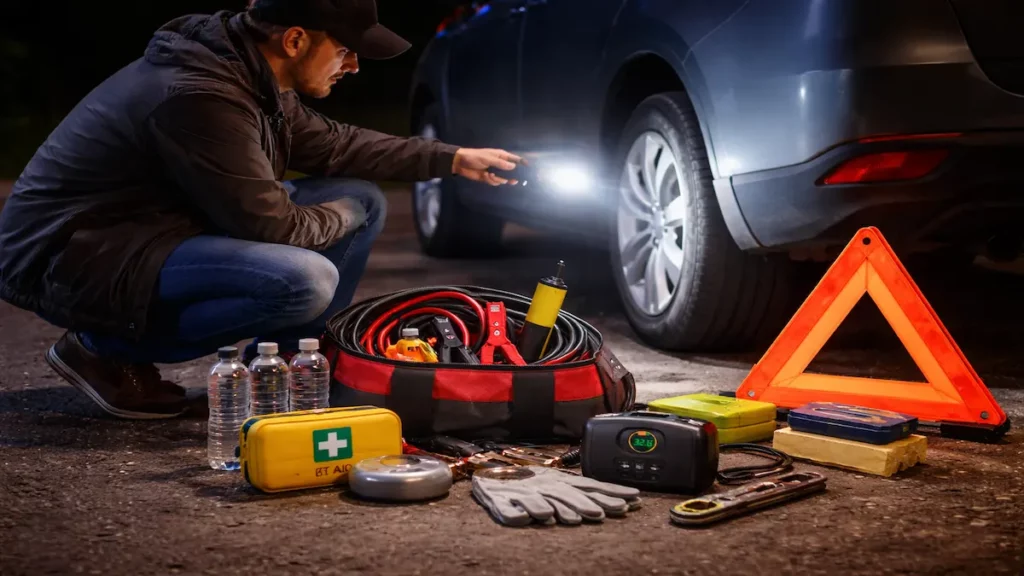
A lot of emergency kit lists focus on fixing the car and forget that the first priority during a roadside stop is staying visible. If you have to pull over on the shoulder, stop on a dark road, or wait in heavy rain or poor visibility, the risk is not just the fault with the vehicle. The bigger danger is that approaching drivers don’t see you early enough.
That’s why a warning triangle, reflective vest, or LED emergency beacon deserves a permanent place in your car emergency kit. Hazard lights help, but they are not enough on their own if you’re stopped somewhere dangerous. A warning triangle placed safely behind the vehicle gives other drivers more notice. A reflective vest makes a huge difference if you need to get out of the car at night or in poor weather.
This is one area where cheap pre-made kits often disappoint. They’ll include the cheapest possible reflective gear just to tick the box. It’s worth spending a little more on something properly visible and durable.
The general safety advice from road safety organisations is pretty consistent here too: visibility matters, especially when you’re stopped near traffic. Guidance from RACV’s roadside emergency kit advice and the National Safety Council’s emergency car kit checklist both reinforce the value of carrying visibility gear and checking your kit regularly.
4. A reliable torch or head torch
A torch sounds basic until you’re trying to inspect a tyre, connect a jump pack, read the owner’s manual, or sort through tools in the dark using your phone light. A proper torch belongs in every car emergency kit because so many roadside problems happen outside daylight hours.
I’d lean towards an LED torch or a head torch rather than the cheapest plastic torch you can find at a discount store. A head torch is especially handy because it keeps both hands free while you’re working. That makes life much easier if you’re inflating a tyre, checking under the bonnet, or digging through a packed boot.
The main thing is maintenance. A torch is only useful if it still works when you need it. If it uses replaceable batteries, keep spares in the kit. If it’s rechargeable, add it to the same six-month check as your jump starter.
5. First aid kit
A first aid kit doesn’t need to be huge, but it should be more than a token pouch with a few plasters rattling around inside. In the context of a car emergency kit, you’re not trying to build a mini hospital. You’re covering minor cuts, scrapes, small burns, and the kind of basic first aid issues that can happen during a roadside stop or long drive.
A practical first aid kit should include plasters, gauze, antiseptic wipes, gloves, medical tape, wound dressings, and basic pain relief if you’re comfortable carrying it. If you regularly travel with children, older relatives, or anyone with specific medical needs, tailor the kit around that reality instead of assuming a generic pack is enough.
This is another item that gets neglected after it’s bought. Adhesives fail in heat, supplies expire, and half the contents get borrowed over time. It’s worth opening the kit every few months to make sure it still contains what you think it does.
6. Phone charger and backup power
A dead phone battery during a roadside issue is one of those completely avoidable problems that still catches people out all the time. Your phone is not just a convenience item anymore. It’s your map, your roadside assistance contact, your weather update, your torch backup, and your way of telling someone exactly where you are.
At minimum, keep a charging cable in the car that fits your actual phone. Better still, keep a 12V charger or USB adapter in the vehicle full time. A power bank is useful too, especially if the car’s electrical system is the problem or you end up outside the vehicle for a while.
It sounds simple, but this is one of the most overlooked parts of a car emergency kit because it doesn’t feel like “automotive gear”. In practice, it’s one of the most important items in the whole setup.
7. Water, snacks, gloves, and an emergency blanket
These are the items that don’t fix the car but make a huge difference if you’re stuck waiting. Water matters in summer, but honestly it matters year-round if you end up stranded for longer than expected. Non-perishable snacks are useful on longer trips or if you’ve got kids in the car. Gloves protect your hands when handling dirty wheels, cables, or hot components. An emergency blanket or spare layer is useful far beyond winter, especially if the breakdown happens late at night or in bad weather.
These aren’t glamorous items, but they’re the kind of things people are very glad to have when a short delay turns into an hour or two.
The Best Car Emergency Kit Setup for Real Roadside Scenarios
A better way to think about your car emergency kit is by scenario.
If the battery goes flat
You want a portable jump starter or jumper leads, a torch, and gloves. If the battery fails at night or in a quiet car park, a self-contained jump pack is far more useful than hoping another driver appears.
If the tyre goes down
You want a tyre inflator, access to your spare wheel or repair kit, and enough light to see what you’re doing. If your vehicle has no full-size spare, learn that now rather than discovering it on the side of the road.
If you have to stop on a dark roadside
You want a warning triangle, reflective vest, hazard lights, and a torch within easy reach. The priority is visibility first, repairs second.
If you’re stranded for a while
You want water, a phone charger, a blanket or extra layer, and enough supplies to stay reasonably comfortable while you wait.
If it’s a small issue you can sort yourself
You want a few practical tools, gloves, and maybe cable ties or tape for a temporary safe fix. That doesn’t mean improvising dangerous repairs. It means being able to secure a loose trim piece, tighten a battery clamp, or deal with something minor without turning it into a recovery call.
Car Emergency Kit Checklist
If you If I were building a realistic car emergency kit for an everyday driver, I’d start here:
- portable jump starter or quality jumper leads
- portable tyre inflator
- tyre sealant if your car uses a mobility kit
- warning triangle or LED roadside beacon
- reflective vest
- torch or head torch
- first aid kit
- phone charging cable and 12V charger
- work gloves
- bottled water
- a few long-life snacks
- emergency blanket
- paper towels or workshop rags
- wet wipes
- a compact multi-bit screwdriver or small tool kit
- printed roadside assistance details or emergency contacts as backup
That covers the majority of real-world breakdown scenarios without turning the boot into a camping supply store.
What to Add if You Do Long Trips, Rural Driving, or Family Travel
Not every driver needs the same emergency kit. A city commuter doing short school runs has different needs from someone regularly doing regional highway miles, family road trips, or rural driving where help may not arrive quickly.
If you travel longer distances or drive in low-traffic areas, I’d add more water, extra snacks, a weatherproof jacket, a larger torch, and a slightly better tool selection. In remote areas, a small problem can become a long wait very quickly. Patchy mobile reception, extreme weather, or long distances between towns all change the equation.
If you travel with children, your car emergency kit should reflect that. Wipes, spare water, child-friendly snacks, and any essential medication become more important than they might seem on a generic checklist. A breakdown with kids in the back seat gets stressful a lot faster when you’re not prepared to keep them comfortable.
Hot weather changes things too. In Australian conditions especially, extra water and sun protection are far from overkill. If you travel into colder or mountainous areas, warm gloves and a heavier blanket make sense. The right car emergency kit is always the one that matches how and where the vehicle is actually used.
Should You Buy a Pre-Made Car Emergency Kit or Build Your Own?
This is one of the most common questions around car emergency kits, and the honest answer is that building your own is usually better, but a decent pre-made kit can still be a good starting point.
A pre-made kit is useful if you currently have nothing at all and want to cover the basics quickly. It’s also handy for gift buying or for drivers who know they won’t bother sourcing every item individually. The downside is that many pre-made kits look more complete than they really are. They often include lots of small filler items but skimp on the things that actually matter, such as jump-start support, inflator quality, visibility gear, or first aid quality.
A DIY kit tends to be the smarter long-term option because you can spend money where it actually counts. You can choose a jump starter suited to your vehicle, a tyre inflator you trust, a first aid kit that isn’t full of junk, and weather-related extras that make sense for your driving.
If you do go the pre-made route, treat it as a foundation rather than a finished solution.
How to Choose the Right Car Emergency Kit for Your Vehicle
The easiest way to waste money on emergency gear is to buy based on marketing rather than actual need. A better way is to ask three simple questions.
What kind of driving do you actually do?
If the car mostly stays close to home, your kit can be fairly compact. You still want battery help, tyre support, visibility gear, first aid, and charging backup, but you may not need the same extended-stranding supplies as someone driving regional routes.
What does the car already come with?
Some vehicles still have a full-size spare. Some have a space-saver spare. Some have no spare at all and rely on a repair kit. Some EVs and hybrids change the battery and recovery conversation completely. If you don’t know what your vehicle came with, check before you buy anything else.
Are you buying for likely problems or imaginary disasters?
This is the big one. The core job of a car emergency kit is to handle realistic roadside issues first: flat battery, tyre trouble, night-time breakdown, minor injury, unexpected delay. Once those are covered, then you can add extra gear based on your comfort level and travel habits.
If you’re trying to avoid wasting money on low-quality gear in general, it’s also worth reading Pickyaura’s piece on car accessory mistakes and low-quality gear red flags because the same buying mistakes show up in emergency kit gear all the time.
Common Car Emergency Kit Mistakes That Leave Drivers Unprepared
The biggest mistake is assuming that owning “a kit” automatically means you’re prepared. It doesn’t.
One common problem is buying a cheap kit full of low-grade tools and never checking what’s actually inside. Another is carrying jumper leads without knowing how to use them safely. Another is burying the entire kit under prams, shopping bags, sports gear, or luggage so it can’t actually be reached in an emergency.
Maintenance gets ignored too. Jump starters go flat because they haven’t been charged in a year. Torch batteries die. First aid kits get raided for plasters and never restocked. Water sits in a hot boot for far too long. The spare tyre is flat because nobody has checked it since the day the car was bought.
There’s also the “wrong gear for the vehicle” problem. Tiny jump packs for large diesel engines, poor-quality inflators that overheat, or sealant kits used in situations they were never designed to solve. The aim is not to own more stuff. The aim is to own the right stuff and keep it ready.
Final Thoughts
A car emergency kit is one of those things that feels unnecessary right up until the day it saves you a long wait, a tow, or a genuinely unsafe roadside situation. That’s why I wouldn’t treat it as a random accessory purchase. It’s part of being prepared for the kind of small but disruptive problems that happen to ordinary drivers all the time.
If you want the short version, focus first on the items that solve real roadside issues: a way to deal with a flat battery, a way to manage tyre trouble, gear that keeps you visible near traffic, a torch that actually works, a first aid kit, and a reliable way to keep your phone alive. After that, tailor the rest to your climate, your vehicle, and the kind of trips you actually do.
You do not need a boot full of survival gear. You need a car emergency kit that works when something ordinary goes wrong at exactly the wrong time. In practice, that’s what makes the difference between a stressful roadside problem and a manageable one.
Frequently Asked Questions
What is the most important item in a car emergency kit?
If I had to pick one, it would usually be a portable jump starter. Flat batteries are extremely common, and a jump starter lets you solve the problem without depending on another vehicle. That said, if you regularly do long remote trips, water, visibility gear, and tyre support become just as important.
Is a portable jump starter better than jumper leads?
For most drivers, yes. Jumper leads still work, but they rely on another vehicle being available and positioned safely. A jump starter is more self-sufficient and usually much more convenient in real breakdown situations.
What should be in a basic car emergency kit for everyday driving?
At minimum, I’d carry a jump starter or jumper leads, a tyre inflator, warning triangle or reflective gear, a torch, first aid kit, phone charger, water, and gloves. That covers the most common roadside problems without taking up too much room.
Should I keep a fire extinguisher in the car?
It can be a useful addition, especially if you do longer trips or want a more complete roadside setup, but it should be a properly rated automotive extinguisher and mounted or stored safely. It’s more of a useful add-on than a core first-purchase essential for most everyday drivers.
Are pre-made car emergency kits worth buying?
They can be a decent starting point if you currently have nothing, but quality varies a lot. Many include filler items and low-grade tools while skipping over the things that matter most. If you want the best result, building your own kit is usually better.
How often should I replace items in my car emergency kit?
Check the kit every six months. Recharge jump starters, test torches, replace expired first aid supplies, and refresh water or snacks if needed. If the car spends a lot of time in extreme heat, inspect those items more often.
Is a Car Emergency Kit Still Worth It If You Have Roadside Assistance?
Roadside assistance is useful, but it doesn’t replace a car emergency kit. It complements one. Roadside cover can help with towing, flat batteries, lockouts, or minor breakdown support, but it does not instantly make you visible on a dark roadside, keep your phone charged, top up a tyre that’s only partly deflated, or keep your family comfortable if you’re waiting an hour for help.
How to Store a Car Emergency Kit So It’s Actually Useful?
Use a proper organiser or durable bag rather than letting tools and loose items roll around the spare wheel well. If you carry water, first aid items, medication, or anything battery-powered, remember that the inside of a parked car gets brutally hot. That doesn’t mean you can’t keep those items there, but it does mean you should check them regularly and replace anything affected by heat.
This is a highly practical and experience-driven guide that effectively emphasizes preparation over reaction, which is critical in real-world driving scenarios. I particularly appreciate the focus on common, preventable issues like battery failure and the importance of maintaining the kit areas many drivers tend to overlook. Your recommendation to build a customized kit rather than relying solely on pre-made options adds strong credibility and real value. The inclusion of environment-specific advice further strengthens the guide, making it relevant and actionable for a wide range of drivers.
Hi Kavitha,
Thank you very much for your valuable feedback.